




Why So Many Small Business Websites Quietly Fail

Ask a small business owner whether their website is working, and most will say yes. It's online. It looks decent. The pages load, the photos are nice, the phone number is right there at the top. By every test the owner knows how to run, the site passes.
And yet a huge number of these perfectly functional websites are failing — quietly, without a single sign that anything is wrong. Not because they're broken, not because they're neglected, but because they were never actually built to do the one job that matters: turn a visitor into a customer.
A website can work perfectly from a technical standpoint while quietly failing at the one thing that actually matters—bringing in customers.
This is the failure nobody catches, because it doesn't look like failure. It looks like a working website. The gap between "functional" and "profitable" is where most small business sites quietly disappear.
"It Works" Is Not the Same as "It Sells"
Somewhere along the way, the definition of a good website got confused. For most owners, a good website means one that looks professional and loads without errors. That's a fair definition of a functional website. It has almost nothing to do with a profitable one.
A functional website is a technical achievement — the code runs, the design is clean, the links work. A profitable website is a business tool — it takes a stranger who's never heard of you, earns their trust in a few seconds, answers the question in their head, and makes it obvious and easy to take the next step. Those are two completely different bars, and clearing the first tells you nothing about whether you've cleared the second.
A website that loads isn't necessarily a website that sells.
The trouble is that "it works" is easy to verify — you can see it with your own eyes. "It sells" is invisible unless you're specifically measuring it. So owners check the thing they can see, it passes, and they reasonably assume the rest is fine. It usually isn't.
What Quiet Failure Actually Looks Like
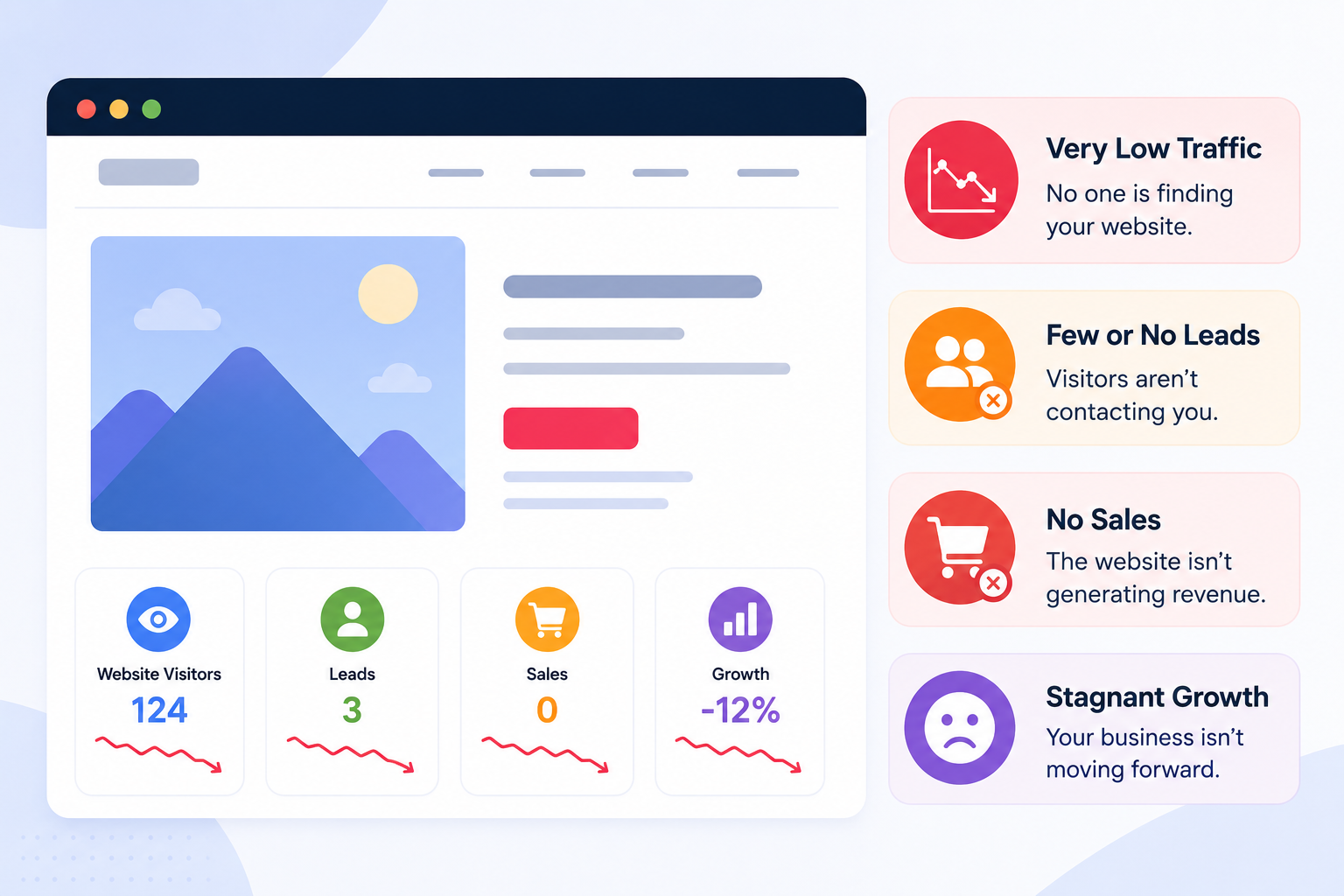
A quietly failing website has a few telltale traits, none of which show up as an error.
It talks about the business instead of the customer. The homepage leads with "Welcome to our company, established in..." instead of speaking to the problem the visitor showed up to solve. Visitors don't care about you yet — they care about whether you can help them — and a site that opens with its own biography loses them in the first few seconds.
It makes the visitor work to figure out what to do next. There's no obvious next step, or there are five competing ones, or the call to action is a polite "Contact us" buried in a menu. Every extra moment of "wait, what am I supposed to do here?" costs you people who would otherwise have reached out.
Every extra second a visitor spends wondering what to do next is another chance for them to leave.
It answers the wrong questions. The site proudly lists services and features but never addresses the actual things standing between a visitor and a decision: How much does this cost? How does it work? Can I trust you? What happens if it goes wrong? Unanswered questions don't become phone calls — they become closed tabs.
It has no clear path from "interested" to "in touch." A visitor who's genuinely ready to act can't easily find how. The form is three clicks deep, the phone number isn't clickable on mobile, the booking process is a mystery. The intent was there; the site just quietly let it evaporate.
None of these are bugs. Every one of them is a site working exactly as built — it just wasn't built to convert.
Why This Happens So Often
The reason so many sites fail this way traces back to how they get made. Most website projects are scoped as design and build jobs, not sell more jobs. The conversation is about pages, colors, and features — how many pages, what should they look like, what functions should they have. It is almost never about the customer's decision-making process, or what specifically needs to happen on the page for someone to choose this business over the competitor one tab over.
So the site gets built to a specification about what it should contain, not a strategy about what it should accomplish. The result is a site that ticks every box on the build list and still doesn't move the needle on the only box that matters — new business. Everyone did their job. The pages exist. The design is clean. And the whole thing quietly underperforms, because "convert visitors into customers" was never actually the assignment.
A website built to satisfy a specification isn't necessarily built to grow a business.
The Fix Isn't a Prettier Site
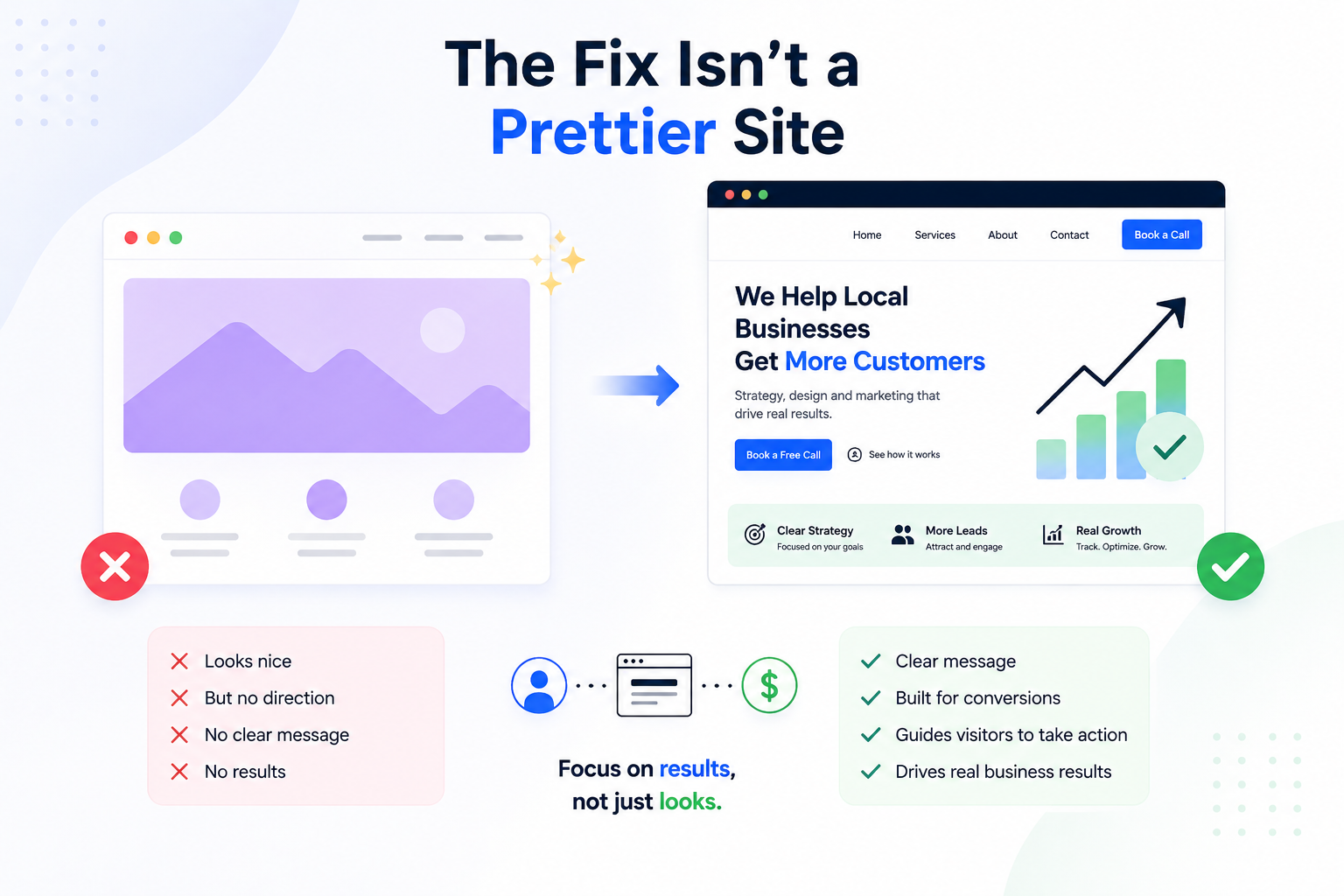
The instinctive response, when a site isn't producing results, is to make it look better — a fresh design, new photos, a more modern layout. Sometimes that helps at the margins. Usually it doesn't, because appearance was rarely the real problem. A beautiful site that talks about itself, buries its call to action, and ignores the visitor's real questions will fail just as quietly as an ugly one.
The actual fix is a shift in what the site is for. It starts by getting clear on who the visitor is, what they're trying to solve, and what would make them comfortable taking the next step — and then building every page around moving them toward that step. That's less a design decision than a strategy decision, and it's the one that separates a site that merely exists from one that earns its keep.
How We Think About It
This is the difference Weblianz starts from: a website isn't a deliverable, it's supposed to produce a result. Over 10+ years and 1,000+ projects — across web, apps, and now AI-driven tools — the throughline has been beginning with the business outcome, not the build spec: who the site needs to reach, what it needs them to do, and how to make that path effortless. It's a big part of why the majority of our clients come back for the next project instead of starting the search over.
If your website looks fine but you can't remember the last time it actually brought in a customer, that's worth paying attention to. A site that "works" but doesn't sell isn't a small problem — it's the most expensive kind, precisely because it never sets off any alarms.
If you want a straight answer on whether your website is actually bringing in business, we're happy to take a look — no pitch, just a real conversation.

Comments
Emma Wilson
This perfectly describes our old website. It looked great but rarely generated inquiries.
ReplyJason Miller
The difference between a functional website and a profitable one is something every business owner should understand.
ReplyRachel Green
Excellent article. We focused so much on design that we forgot about conversions.
ReplyDavid Parker
The point about websites talking about the business instead of the customer really stood out to me.
ReplySophia Carter
Very practical advice. This explains why simply redesigning a website often doesn't solve anything.
ReplyKevin Brown
One of the clearest explanations I've read about why websites fail without anyone noticing.
ReplyLeave a Comment
Your email address will not be published. Required fields are marked *