




We Talked to Small Business Owners About Their Websites. Here's What Went Wrong.

There's a particular kind of tired that comes from paying for something twice.
Not because you wanted to. Because the first version never really worked — it just took months of silence, a launch date, and a slow realization that the site everyone was so excited about wasn't bringing in a single new customer.
Talk to enough small business owners about their websites, and you start hearing the same story on repeat. Different industries, different budgets, same shape: an owner hires someone to "build a website," gets something that technically exists, and ends up no closer to the actual goal — more customers, more bookings, more revenue.
So we started asking a simple question: what actually goes wrong?
"Most small businesses don't have a website problem," says one small business marketing consultant who's worked with dozens of local companies. "They have a 'nobody asked the right question before we started building' problem. The website is just where that shows up."
The Pattern Nobody Talks About
The businesses we spoke with weren't unhappy because their website looked bad. Most of them looked fine. The problem was almost always somewhere else — in how the project got built in the first place.
Pattern 1: The project starts with a website goal, not a business goal.
Almost every conversation started the same way: "We needed a website, so we hired someone to build a website." That sounds reasonable, but it's backwards. A restaurant owner doesn't need a website — they need more reservations. A contractor doesn't need a portfolio page — they need qualified leads calling them, not tire-kickers. When the project is scoped around "build me a site" instead of "solve this business problem," you get a deliverable, not a result.
Pattern 2: Fast and cheap usually means invisible six months later.
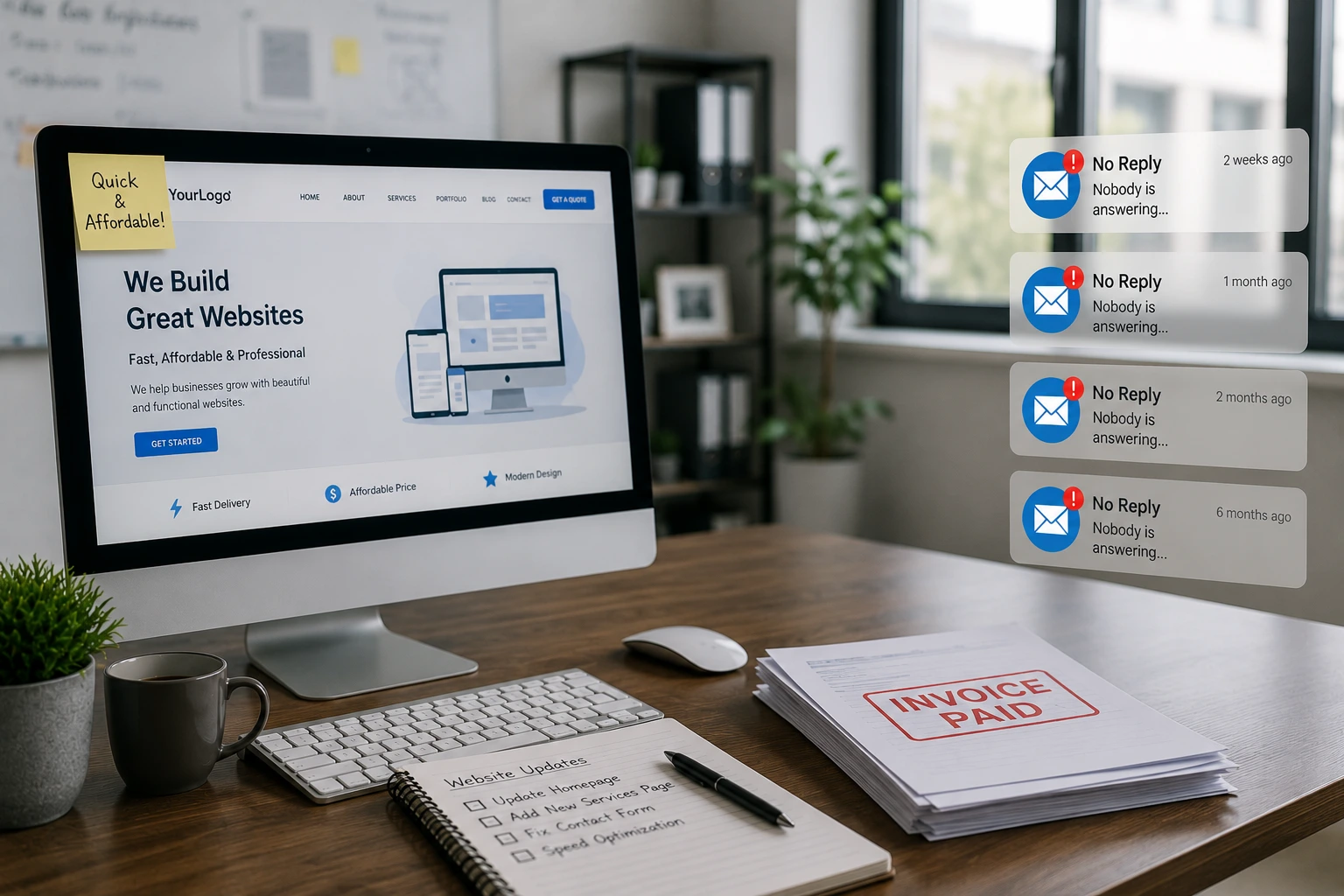
A lot of owners told a version of this story: the initial build was quick and inexpensive, which felt like a win — until the site needed an update, a new page, or a fix, and suddenly nobody was answering emails. The site wasn't broken. It just quietly stopped being anyone's priority the moment the invoice was paid.
Pattern 3: Communication disappears right after the contract is signed.
This came up more than anything else. During the sales conversation, everything is responsive and reassuring. Once the deposit clears, updates get slower, questions take days to answer, and by launch, the relationship feels less like a partnership and more like a transaction that's now over. Owners don't just want a website — they want to feel like someone is paying attention.
"The number one complaint I hear isn't about design or price," notes a web development industry veteran of 15 years. "It's 'I couldn't get anyone on the phone after we signed.' That single issue does more damage to trust than almost anything else."
Pattern 4: Redesigns keep happening because the real problem never gets fixed.

Several owners had gone through this more than once — a redesign every year or two, a new agency, a new "final answer" — without ever addressing why the last one didn't work. The website changed. The process that produced it didn't.
What the Happy Ones Did Differently
Here's the interesting part: the businesses that ended up satisfied weren't necessarily the ones who spent the most. They were the ones who started with a real conversation before any code was written — someone asking what the business actually needed, not just what pages to include. They also tended to work with teams who stuck around after launch, instead of treating delivery as the finish line.
In other words, the fix wasn't a bigger budget. It was a different starting point.
"The businesses that get it right treat the first conversation like a diagnosis, not a sales call," says a small business growth advisor who's guided owners through dozens of vendor decisions. "If nobody's asking about your customers before they start talking about your website, that's the first red flag."
Why We Built Our Process Around This
This is the exact problem Weblianz was built to solve. Across web, app, and now AI-driven tools, the throughline has been the same: start with the business problem, not the build spec, and stay in the conversation after launch instead of disappearing. It's a big part of why the majority of our clients come back for the next project instead of shopping around again.
That discipline looks different depending on the business. For a trading platform like Galileo FX, it meant designing around what traders actually needed to trust the software, not just what looked good in a mockup. For an EdTech platform like Training Camp, it meant building a learning experience around how students and instructors actually use the product day to day. And it's the same starting point we've carried into work with Single Rulebook, wfp.org, and merly.ai — different industries, same first question: what's the actual business problem here, before a single line of code gets written.
We're not claiming to be the only company that works this way. But if the patterns above sound familiar — if you've been burned by silence, by a "finished" site that didn't move the needle, or by a redesign that just repeated the same mistake — it might be worth a different kind of first conversation.
If you're currently evaluating who to work with, we're happy to just talk it through — no pitch, just answers.

Comments
Sarah Johnson
This article perfectly describes our experience. We paid for a website that looked great but never generated any leads. Looking back, nobody ever asked about our business goals.
ReplyMichael Brown
The communication point really stood out to me. Everything was fast before signing the contract, then it became almost impossible to get updates afterward.
ReplyPriya Nair
We went through two redesigns before realizing the problem was never the design itself. This article nails it.
ReplyDavid Chen
Wish we'd read something like this before our first build. We scoped the whole project around "a website" instead of "more bookings."
ReplyAmanda Lopez
The point about vendors disappearing after the deposit clears is so real. That was our exact experience with our first agency.
ReplyRavi Kumar
Great breakdown. Starting with the business problem instead of the build spec is such a simple shift but it changes everything.
ReplyLeave a Comment
Your email address will not be published. Required fields are marked *