




The Real Reason Your Business Website Isn't Bringing in Customers

If your website isn't bringing in customers, the usual suspects get blamed first. The design looks dated. The site's too slow. You're not spending enough on ads. Maybe it needs more pages, or a blog, or a fresh coat of paint.
Sometimes one of those is the culprit. But very often, a business pours money into fixing all of them and still hears crickets — because none of them was the real problem. The real reason is quieter and harder to see: your website doesn't clearly tell the right person that it's for them.
Before visitors buy from your business, they need to recognize that your business is meant for them.
A visitor lands on your site and, within a few seconds, silently asks three questions — Is this for me? Can they solve my problem? Why them and not someone else? If the site doesn't answer all three, fast and clearly, the visitor leaves. Not angry, not disappointed. They just don't recognize themselves in what they're seeing, so they move on. That failure to connect is what's actually costing you customers — and no amount of design polish fixes it if the message underneath is off.
"Is This For Me?" — The Question of Clarity
The most common reason a website doesn't convert is that a visitor can't quickly tell whether the business is even meant for someone like them.
Picture a plumber's site that leads with "Quality plumbing solutions for all your needs." It's not wrong — it's just so broad that it says nothing. A homeowner with a burst pipe at 9pm, a property manager handling twelve units, and a contractor sourcing a subcontractor are three completely different customers with different worries, and that headline speaks to none of them specifically. When a site tries to speak to everyone, it lands with no one. Visitors need to see themselves — their situation, their words, their problem — reflected back quickly, or they assume they're in the wrong place.
When your message tries to speak to everyone, it rarely speaks clearly to anyone.
The fix isn't more words. It's sharper ones: being specific about exactly who you help and what situation you solve, even at the apparent cost of "excluding" people who were never really your customers anyway.
"Can They Solve My Problem?" — The Question of Proof
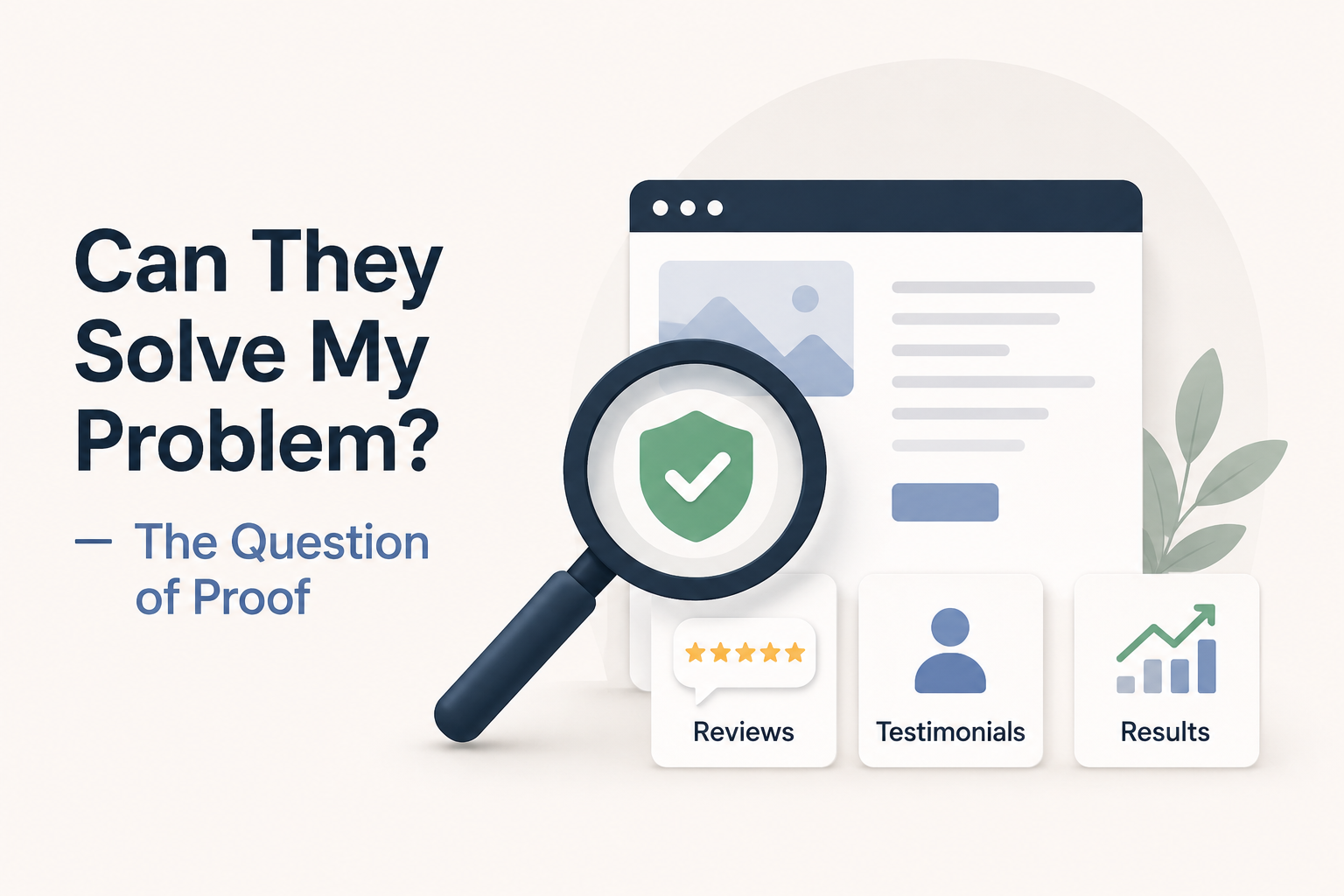
Say the visitor does recognize themselves. The next silent question is whether you can actually deliver — and this is where most sites reach for the wrong evidence.
Businesses tend to answer "can you solve my problem?" by talking about themselves: years in business, list of services, a mission statement about quality and dedication. But a nervous visitor isn't reassured by your self-description; they're reassured by proof that someone like them got the result they want. A short, specific testimonial from a similar customer does more than three paragraphs about your company values. A concrete before-and-after does more than a page of adjectives. The site has to shift from asserting it's good to demonstrating it, in terms the visitor's situation makes real.
Customers don't trust what you say about yourself nearly as much as they trust evidence that you've helped someone like them.
When that proof is missing, the visitor has only your word for it — and a stranger's word, on their own website, is the weakest evidence there is.
"Why You and Not Someone Else?" — The Question of Difference
The third question is the one most small business websites completely ignore. A visitor comparing you to the two other tabs they have open needs a reason to choose you — and "we're professional, reliable, and customer-focused" is not a reason, because every competitor says exactly the same thing.
When every option sounds identical, the visitor falls back on the only thing left to compare: price. That's how good businesses get dragged into competing on being the cheapest, purely because their site never gave anyone a better reason to pick them. Genuine differentiation doesn't have to be dramatic — a specific specialty, a particular way you work, a guarantee, a focus on a certain kind of client. It just has to be something true that the others aren't also claiming. Without it, you're not a choice; you're one interchangeable option in a list, and interchangeable options lose.
If your competitors can honestly copy every sentence on your homepage, your website isn't giving customers a reason to choose you.
Why Polish Doesn't Fix a Message Problem
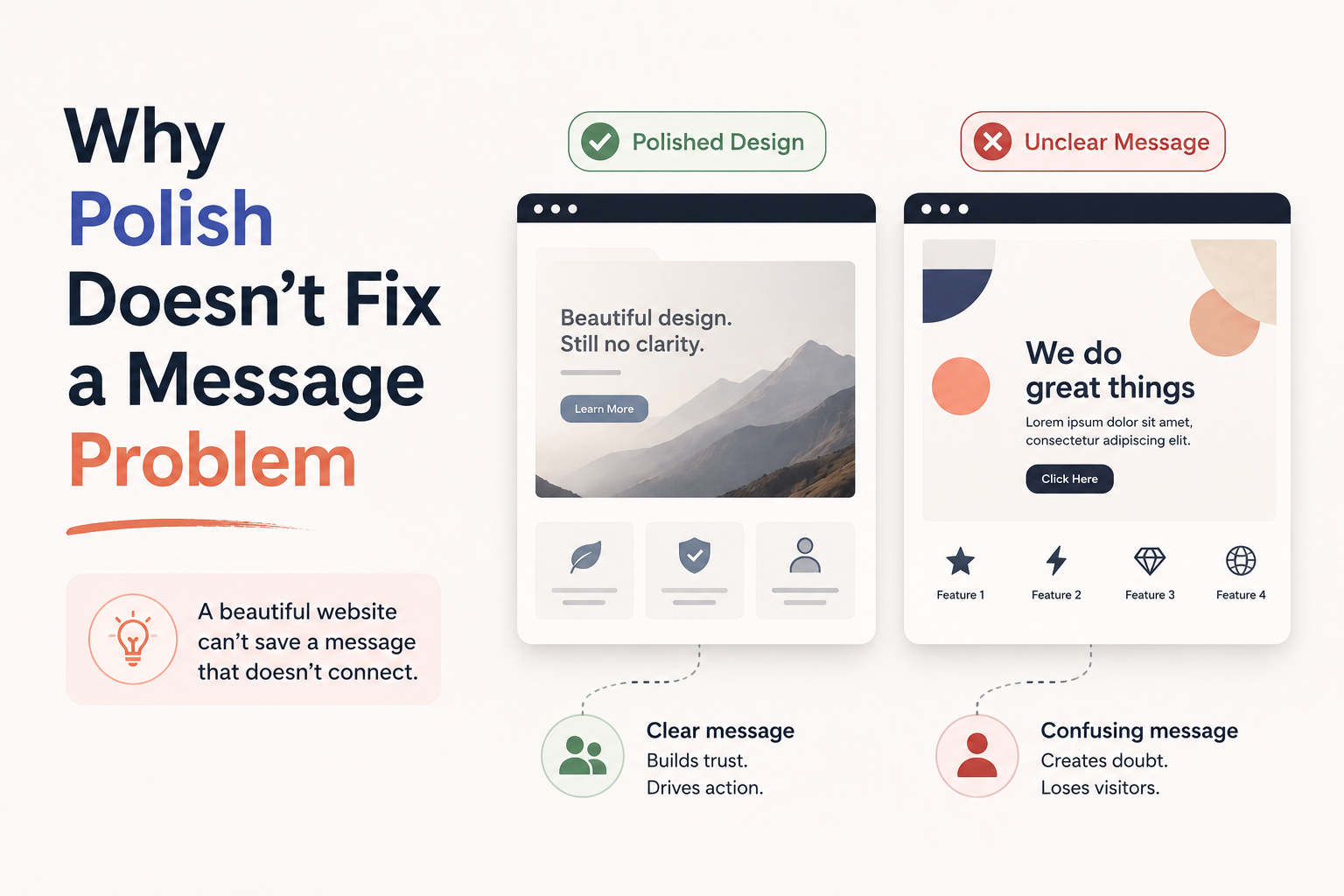
Here's why so much money gets wasted chasing this. All three of these are message problems, and the instinct is almost always to reach for a design solution. So the business redesigns. The new site looks fantastic — and still doesn't bring in customers, because it's the same unclear message in a nicer frame.
A beautiful website that doesn't tell the right person it's for them, prove it can help, and give a reason to choose it will fail exactly as reliably as an ugly one. Design can make a strong message land harder, but it cannot rescue a weak or missing one. This is why "make it prettier" so often disappoints: it treats the symptom the owner can see instead of the cause they can't.
The uncomfortable but useful truth is that fixing the words usually matters more than fixing the looks. And fixing the words starts not at the keyboard but with a clear understanding of who you're actually talking to and what they need to hear.
How We Think About It
This is where Weblianz starts every project: not with layouts, but with the customer and the message. Over 10+ years and 1,000+ projects — across web, apps, and now AI-driven tools — the throughline has been getting clear first on who the site needs to reach, what they need to hear, and why they should choose this business, then building around that. A site built on a clear message and then designed well is the combination that actually brings in customers. It's a big part of why the majority of our clients come back for the next project instead of starting the search over.
If your website looks fine but the phone isn't ringing, the problem probably isn't the part you can see. It's worth figuring out what your site is really saying to the people who land on it — because that's the thing quietly deciding whether they stay or go.
If you want a straight answer on why your website isn't bringing in customers, we're happy to take a look — no pitch, just a real conversation.

Comments
Rachel Evans
This article helped me realize our website talks far too much about us instead of our customers.
ReplyNathan Brooks
The three questions every visitor asks completely changed how I look at website copy.
ReplyOlivia Martin
Excellent explanation of why design alone doesn't generate leads.
ReplyDaniel Foster
We redesigned our website twice before realizing our messaging was the real problem.
ReplyEmily Watson
Simple advice that every small business owner should hear before investing in another redesign.
ReplyKevin Harris
The examples in this article make the concepts incredibly easy to understand.
ReplyLeave a Comment
Your email address will not be published. Required fields are marked *