




The 3 Questions Every Small Business Should Ask Before Hiring a Developer

Most business owners choose a developer or agency the same way: look at the portfolio, compare a couple of quotes, pick the one that feels most trustworthy. It's a reasonable process — and it predicts almost nothing about whether the relationship will actually work.
Here's the problem. You're not in a position to judge someone's code quality or technical chops in a sales call, and you shouldn't have to be. But you can judge how they answer a few specific questions — and the answers tell you almost everything about how the next six months are going to go. These are the three worth asking before you sign anything.
Question 1: "What business problem are we actually solving?"
Ask this before any conversation about pages, features, or design. A good developer or agency will ask you questions back — about your customers, where leads currently come from, what "success" looks like three months after launch. They're trying to understand the business, not just the build.
A red flag looks like the opposite: they jump straight into "so, how many pages do you need?" or start pitching templates and add-ons before understanding what you're actually trying to fix. That's a sign the project will be scoped around a deliverable, not a result — and deliverables don't grow revenue on their own.
Question 2: "What happens after launch?"
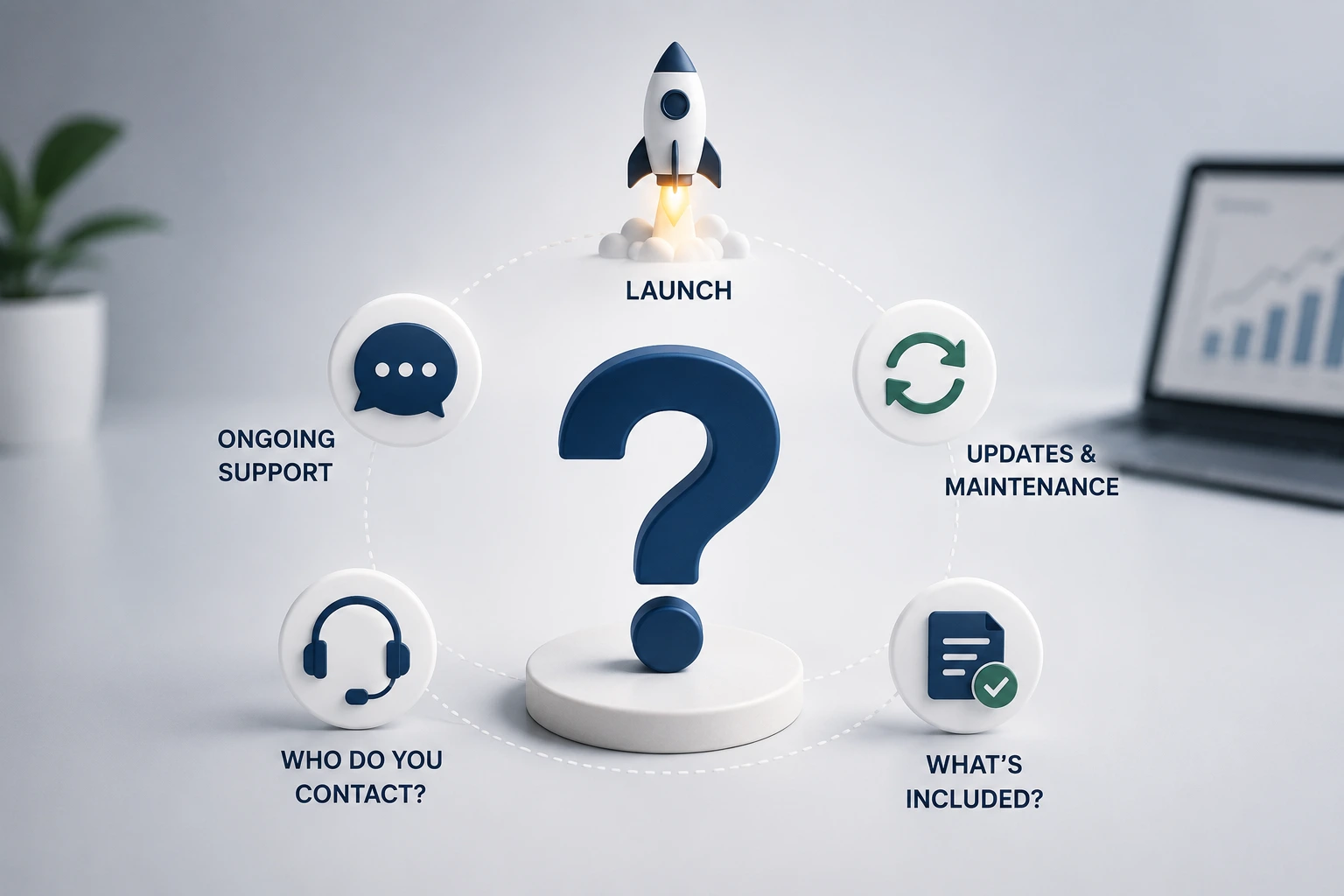
This is the question that separates a vendor from a partner. Ask specifically: who do I contact if something breaks, how are updates handled, and what does support actually include after the invoice is paid.
A good answer is concrete — a named point of contact, a clear process, maybe even examples of what they've fixed or improved for other clients months after delivery. A vague answer — "oh, we'll be around if you need anything" — usually means you won't be able to reach anyone once the project wraps. This is the single most common complaint business owners have after a bad hire, and it's almost entirely avoidable if you ask upfront.
Question 3: "Can I talk to a client from a year ago, not just a new one?"
Anyone can produce a happy client from last month — the honeymoon period after launch is easy to manufacture. What's harder to fake is a client who's still around, still happy, a year later.
If a developer or agency can't point you to someone who's stuck with them well past delivery, that tells you something. If they can, ask that reference one specific question: would you hire them again, and did anything change after the contract was signed? The answer to that second part is usually the real story.
Why These Three Questions
These aren't arbitrary. They map to the three moments where most web and software projects quietly go wrong — before the build starts, right after launch, and long after anyone's paying attention. A team that handles all three well isn't just good at building websites or apps; they're good at staying in the relationship past the point where it's convenient.
It's also, not coincidentally, the standard we hold ourselves to. The majority of Weblianz's clients come back for the next project instead of shopping around again — which is really just another way of saying the answers to these three questions have stayed consistent for us, year after year.
That consistency holds across very different kinds of work. With a trading platform like Galileo FX, question one — what business problem are we actually solving — shaped everything before a single screen got designed. With an EdTech platform like Training Camp, question two is the one that mattered most: staying reachable and involved long after the initial launch, not disappearing once the invoice cleared. It's the same three questions we've carried into work with Single Rulebook, wfp.org, and merly.ai — different industries, same standard applied every time.
If you want to ask us these three questions directly, we're happy to answer them — no pitch, just a real conversation.

Comments
Emily Carter
The question about what happens after launch is something I wish I had asked before hiring our last agency.
ReplyJames Wilson
This article should be required reading for every small business owner planning a new website.
ReplySophia Martinez
The advice about talking to a client from a year ago is brilliant. That tells you far more than any portfolio ever could.
ReplyRaj Patel
We hired based on price the first time and regretted it. These three questions would have saved us a lot of money.
ReplyOlivia Harris
I really like the focus on solving business problems instead of just building websites. That mindset changes everything.
ReplyDaniel Kim
Simple, practical advice with questions anyone can ask, even without a technical background.
ReplyLeave a Comment
Your email address will not be published. Required fields are marked *