




How Much Does It Really Cost to Build Business Software?

It's the first question almost everyone asks, and the one that's hardest to answer honestly: what does it cost to build business software?
The frustrating truth is that "it depends" is actually the correct answer — but that's useless to someone trying to plan a budget. So instead of dodging it, let's do something more helpful: explain what the price actually depends on, why quotes for the "same" project can range from a few thousand to a few hundred thousand, and how to tell whether a number you've been given is reasonable. By the end, you won't have a single figure, but you'll have something better — the ability to understand any quote you're given and spot the ones that will hurt you later.
Why "How Much Does Software Cost?" Is Like "How Much Does a Building Cost?"
Asking what software costs is a bit like asking what it costs to construct a building. A garden shed and a hospital are both "buildings," but nobody would expect them to cost the same, because the word describes a category, not a thing.
Software is identical. A simple internal tool that does one job for a handful of employees and a customer-facing platform that handles payments, accounts, and thousands of users are both "business software," but they live in completely different price universes. The first step to understanding cost isn't getting a number — it's understanding which building you're actually trying to construct. Most wildly different quotes for the "same" project happen because each person was quietly imagining a different building.
What Actually Drives the Cost

A handful of factors do most of the work in determining price. Understanding them lets you see why a quote is what it is.
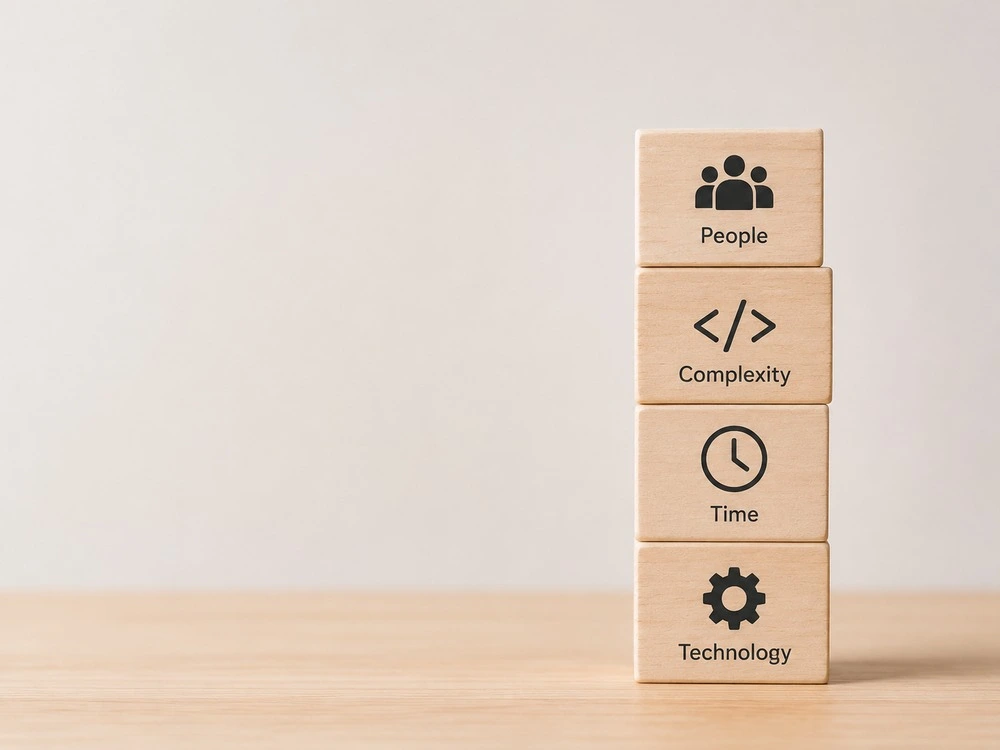
Complexity of what it does. A tool that displays and edits information is simpler than one that makes decisions, runs calculations, handles logic, or coordinates between many moving parts. The more the software has to actually do, the more it costs.
Number and type of users. Software for five internal staff can cut corners that software for ten thousand paying customers cannot. Public, customer-facing products carry higher costs because they need to handle scale, unpredictable behavior, and a level of polish that internal tools can skip.
Integrations. Software rarely lives alone — it usually needs to talk to other systems: payment processors, existing databases, third-party services, other tools you already use. Every connection point adds work, and integrations are one of the most commonly underestimated cost drivers.
Data and security requirements. Handling sensitive information — payments, health data, personal records — raises the cost, because it has to be done to a higher standard. This isn't optional padding; cutting it is how businesses end up with expensive problems later.
Design and user experience. Something people will use every day, or that customers will judge your business by, needs real design attention. A rough internal tool can look plain; a customer-facing product usually can't.
None of these are line items you can remove to save money without consequence. They're descriptions of what you're actually asking for. A lower quote often just means someone quietly assumed less of one of them.
Why the Cheapest Quote Is Usually the Most Expensive
When quotes vary widely, the instinct is to pick the low one. It's often the most expensive choice in disguise.
A suspiciously low quote usually means one of a few things: the person didn't fully understand the scope and will come back later with "that wasn't included," they're cutting corners you can't see yet (on security, testing, or the parts that make software maintainable), or they're planning to win with a low number and make it up through change requests once you're committed. All three end the same way — the final cost lands far above the quote, plus the stress of getting there.
The genuinely cheap path isn't the lowest bid. It's the quote from someone who understood the problem well enough to price it accurately the first time, built it properly so it doesn't need expensive rescuing, and stayed reachable afterward so small issues stay small. Paying a fair price once almost always beats paying a low price twice.
The Cost Everyone Forgets: After Launch
Here's the part left out of most budgets. Software isn't a one-time purchase; it's a thing you run. It needs maintenance, occasional fixes, updates as the world changes around it, and adjustments as your business grows.
A quote that only covers building the software, with no thought to what happens after, isn't a complete picture of the cost — it's just the first installment. Businesses that budget only for the build are the ones caught off guard six months later when the tool needs attention and there's nothing set aside for it. When you're weighing cost, ask not just "what does it cost to build?" but "what does it cost to keep running?" The second number is smaller, but ignoring it is how good software quietly falls apart.
How to Actually Control the Cost
The good news is you have more control over cost than it feels like — just not by haggling. The real levers are earlier.
Start by getting genuinely clear on the problem you're solving, so you're not paying to build things you don't need. Insist on starting with the smallest version that delivers real value, rather than building everything at once and discovering too late that half of it wasn't necessary — this single choice controls cost more than any other. And choose a partner who prices honestly and explains the trade-offs in plain language, so you can make informed decisions about where to spend and where to hold back. Cost control isn't about spending as little as possible; it's about making sure every dollar is pointed at something that actually matters to your business.
How We Approach It
This is exactly the order Weblianz works in. Across web, apps, and now AI-driven tools, the throughline has been the same: understand the real problem before proposing a build, define what success looks like, start lean, and stay in the relationship long after launch. It's a big part of why the majority of our clients come back for their next project instead of starting the search over.
That order shows up the same way across very different clients. With a trading platform like Galileo FX, it meant getting clear on the actual problem before any screen got designed. With an EdTech platform like Training Camp, it meant defining what "working" looked like early, then staying in the relationship well past launch instead of treating delivery as the finish line. It's the same approach we've carried into work with Single Rulebook, wfp.org, and merly.ai — different industries, same starting point: understand the problem before proposing the build.
If you're trying to budget for a software project — or just want an honest read on what your idea should realistically cost — the most valuable step is often just talking it through with someone before committing to anything.
Book a free consultation, or start a chat with us — no pressure, just a straight, honest conversation about what your project should really cost.

Comments
Priya Chandra
The building vs. shed comparison finally made this click for me. We kept comparing quotes like they were for the same thing when they clearly weren't.
ReplyTom Reyes
Learned the "cheapest quote is the most expensive" lesson the hard way. The change requests ate way more than the gap between the low and mid quotes ever would have.
ReplyNadia Boesch
Nobody talks about the after-launch cost until you're the one blindsided by it six months in. Wish this had been the first thing someone told us.
ReplyJulian Voss
Integrations were exactly what got underestimated in our project. Every "quick connection" turned out to be its own small project.
ReplyMeredith Okafor
Starting with the smallest version that actually delivers value was the single biggest cost saver for us. We would have built twice as much and needed half of it.
ReplyDaniel Ferris
Same here — the stuff we thought was "essential" before launch turned out to be the stuff nobody touched after.
ReplyLeave a Comment
Your email address will not be published. Required fields are marked *